
There’s a video on the internet that ruins movies — or saves them, depending on your perspective. It’s a behind-the-scenes clip of actors performing on a bare grey stage, surrounded by nothing but green fabric and numbered ping pong balls on sticks. The ping pong balls will become monsters. The grey stage will become a battlefield. The actors are, for now, just people in costume, talking to air.
That is CGI filmmaking in its rawest form. And when you see the finished product side by side with the raw footage, it’s one of the most astonishing transformations in modern art.
The Scenes That Changed Everything
01 — The T-Rex Attack | Jurassic Park (1993)
Before CGI: A 9,000 lb hydraulic T-Rex puppet, drenched by rain machines, operated by a crew of 12. Spielberg used a real mechanical dinosaur for close-ups — terrifyingly convincing until it malfunctioned in the rain.
After CGI: ILM added a fully digital T-Rex for wide shots — the first time a major film used photorealistic CG creatures. The blend was so seamless that audiences couldn’t tell which shots were puppet and which were pixels.
This is ground zero for modern CGI cinema. Spielberg originally planned to use stop-motion animation, but ILM’s test reel of a moving digital dinosaur changed cinema history. The T-Rex breakthrough proved that computers could create believable living creatures — and the film industry never looked back.

02 — The Battle of Helm’s Deep | The Lord of the Rings (2002)
Before CGI: 600 real extras, hundreds of costumes, weeks of night shoots in New Zealand. The physical production was enormous — and it still looked like 600 people, not 10,000.
After CGI: Weta Digital’s proprietary AI software “MASSIVE” gave each digital soldier its own brain — they made individual decisions in combat, creating chaos that no choreographer could direct.
The MASSIVE software was a genuine technological revolution. Each digital combatant had its own behavioural logic — orcs attacked, elves defended, soldiers fled when surrounded. The result was a battle scene of unprecedented scale and believability. It won the Academy Award for Visual Effects, and rightfully so.
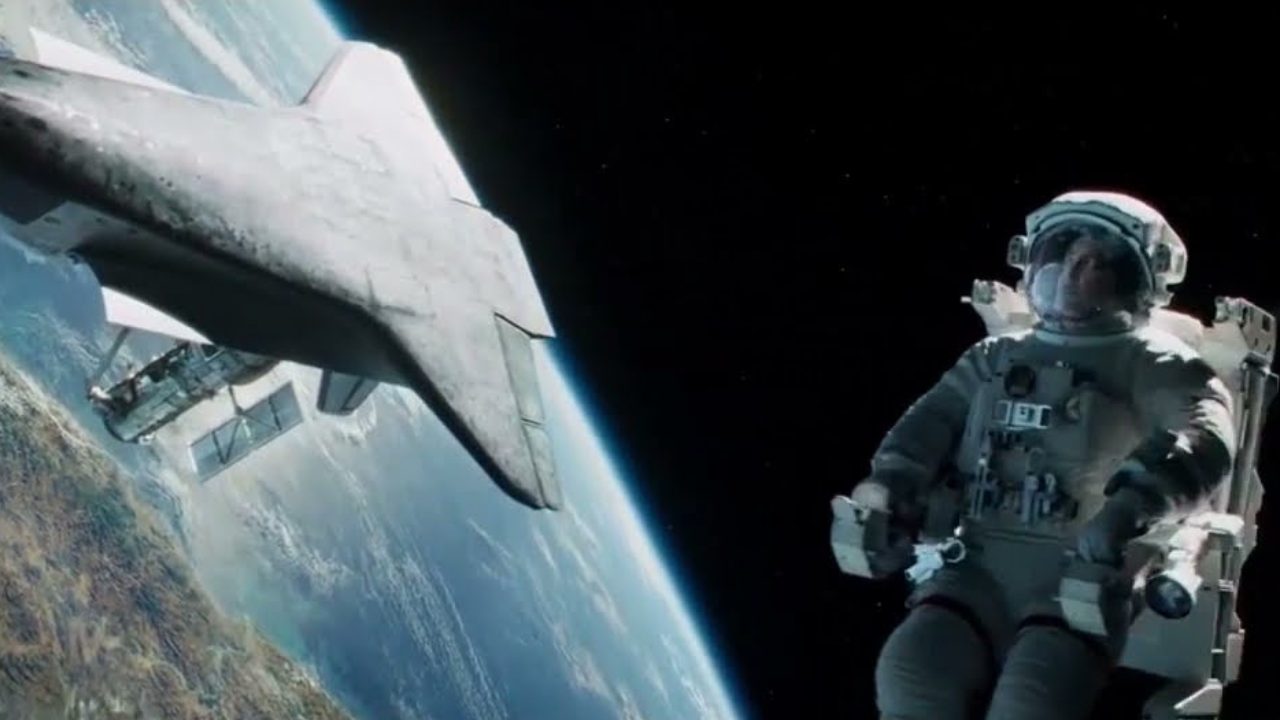
03 — The Opening Sequence | Gravity (2013)
Before CGI: Sandra Bullock spent months in a custom “light box” — a 9×9 ft cube of 4,096 LEDs — suspended in wire rigs, with only her face visible. The rest of her body and the entire environment were added in post.
After CGI: Every star, every debris field, Earth’s atmosphere, the space station — all digital. Even Bullock’s spacesuit was partially computer-generated to simulate zero-gravity fabric movement.
Gravity is arguably the most technically ambitious CGI achievement in film history. The opening 13-minute single-take sequence required four years of development. Director Alfonso Cuarón essentially invented new filmmaking technology to make it possible.
04 — Thanos | Avengers: Infinity War (2018)
Before CGI: Josh Brolin performed every scene in a grey mocap suit with 57 tracking dots on his face alone. He acted opposite real actors on real sets — his performance was entirely captured, then rebuilt.
After CGI: Weta Digital rebuilt Brolin’s performance inside a digital giant, preserving every muscle twitch, every eye movement. The result was a villain audiences genuinely empathised with.
What makes Thanos extraordinary isn’t the scale — it’s the subtlety. The CGI team spent months ensuring that grief, doubt, and conviction read on a digitally constructed face. This is performance capture at its peak: technology in complete service of emotion.

How CGI Evolved — A Brief Timeline
1977 — Star Wars uses early computer graphics for the Death Star briefing screen — the first CGI shot in a major Hollywood film.
1991 — Terminator 2 introduces morphing and liquid-metal CGI. James Cameron proves computers can create characters, not just environments.
1993 — Jurassic Park creates photorealistic living creatures. The modern CGI era begins.
2001 — The Lord of the Rings introduces performance capture with Gollum — Andy Serkis’s face drives a fully digital character for the first time.
2009 — Avatar invents a new visual language. James Cameron builds an entire alien world from scratch — 60% of the film is CGI.
2023–present — AI-assisted VFX begins reshaping the industry. De-aging, digital doubles, and generative backgrounds become standard tools — raising profound questions about the future of actors and sets.
What Before vs After Really Reveals
The before-and-after footage is humbling precisely because it forces you to reckon with what you took for granted. That alien planet was a parking lot. That army was six actors and a software program. That villain was a man in a grey suit talking to nobody.
CGI is often criticized — sometimes fairly — for enabling laziness, for replacing practical craft with digital shortcuts, for making everything look the same shade of brown and grey. But at its best, it is simply an extension of the oldest impulse in cinema: the desire to show audiences something they have never seen before.
The green screen isn’t the enemy of imagination. In the right hands, it’s where imagination begins.

Mohit Swami is the Head of Content at GYANTV, overseeing content strategy, editorial planning, and quality control across the platform. With experience in managing digital content workflows, he ensures that every article aligns with accuracy standards, audience relevance, and ethical publishing practices. His work focuses on building trustworthy, engaging, and reader-first content in health, lifestyle, and trending news categories.